

Hello!
Now that the heat is fading and the merciless sun’s rays have gone, over the coming weeks I’ll be focusing more on decoration than on sun protection, although these two subjects tend to go hand in hand.
I’ll start with Japanese panels because this is a type of curtain that decorates and divides any room in an elegant way. It’s also a very current style of curtain.
As the name suggests, this type of curtain was, and still is, used in Japanese homes to cover large windows and bring a sense of serenity and calm.
Nowadays, it adapts to all kinds of spaces (restaurants, homes, hotels, etc.) and it really is a very effective product for covering large windows. They’re ideal for bedrooms, kitchens with big windows, living rooms, dining rooms, terraces and porches.
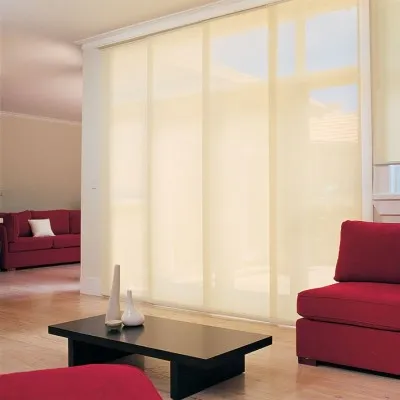
Japanese panel: smooth, fluid movement
Japanese panels are made up of narrow, independent fabric panels that run from ceiling to floor (preferably) and slide sideways along rails fixed to the ceiling, giving the room a sleek, elegant and cutting-edge look.
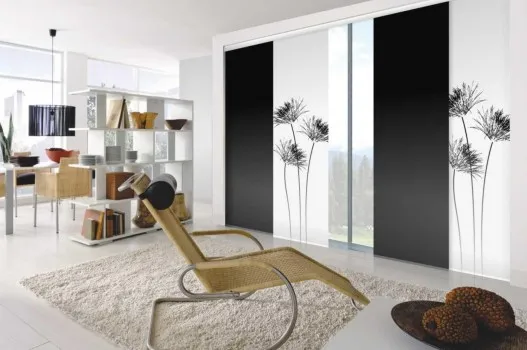
Combined sliding panel
Like everything in life, panels have advantages and disadvantages.
The advantages are as follows:
-
They adapt perfectly to minimalist settings, which is hardly surprising given their Japanese origin.
-
They allow for endless combinations, making them a very easy option for almost any type of decor.
-
They’re practical to care for and clean. The panels attach to the rail with velcro, so they’re very easy to unhook for washing.
-
They add privacy to a room while also being very effective at filtering light.
-
Since each panel is an independent piece of fabric, you can mix and match colours so the panel fits each client’s décor and taste, and even combine textures and materials.
-
They’re ideal for sliding doors onto terraces and gardens, large windows, etc.
-
They can be used as a kind of “screen” to divide different areas within a single room.
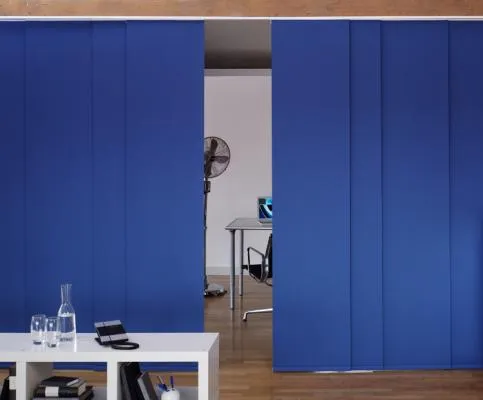
Japanese panel: an option for dividing spaces
Their disadvantages are:
-
It’s not advisable to combine a screen fabric with a regular fabric, as it would spoil the elegance of the curtain.
-
Since each panel is an independent piece of fabric, when a Japanese panel is drawn back, there will always be one panel left in front of the glass.
-
It can’t be fitted to a standard-sized window, because when the panel is drawn back it would take up the width of one panel and cover part of the window.
Here are some more pictures so you can judge for yourselves.
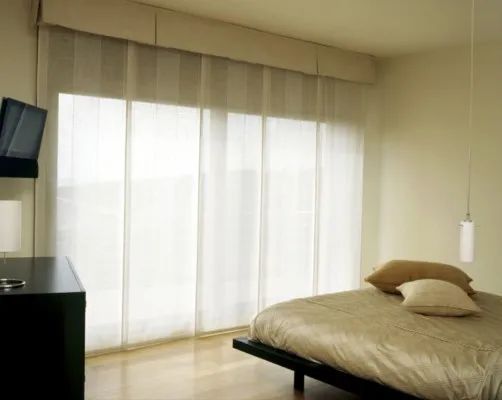
Japanese panels in bedrooms
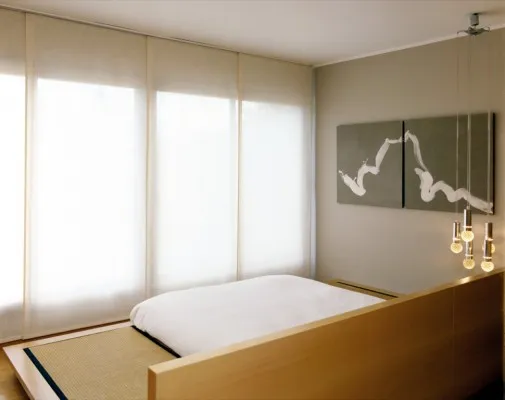
Sliding panels for bedrooms
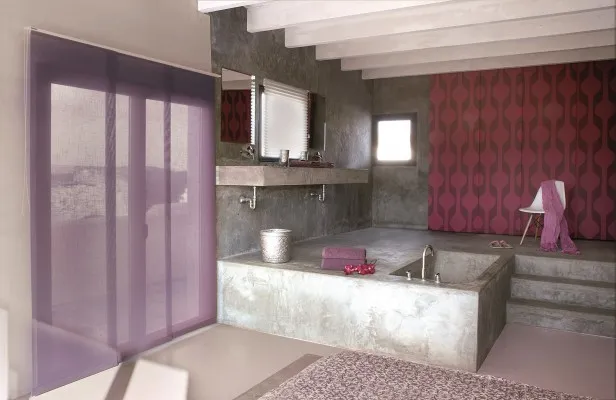
Japanese panel in bathrooms
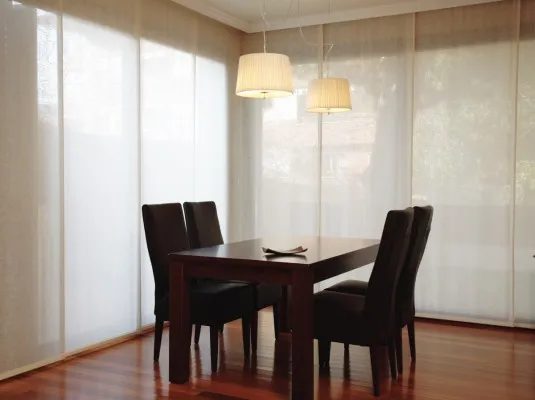
Japanese panels for the living room


